Tracking the Criminalization of Homelessness
For years, politicians have been passing laws that make it a crime to experience homelessness. These laws punish people who can’t afford a place to live and have to sleep in public. Previously, we mostly saw these laws at the local level. Now, we’re seeing a coordinated push for those laws at the state level, backed by billionaire think tanks like the Cicero Institute. At the same time, governments are reducing funding for housing and supportive services, the only proven solutions to homelessness.
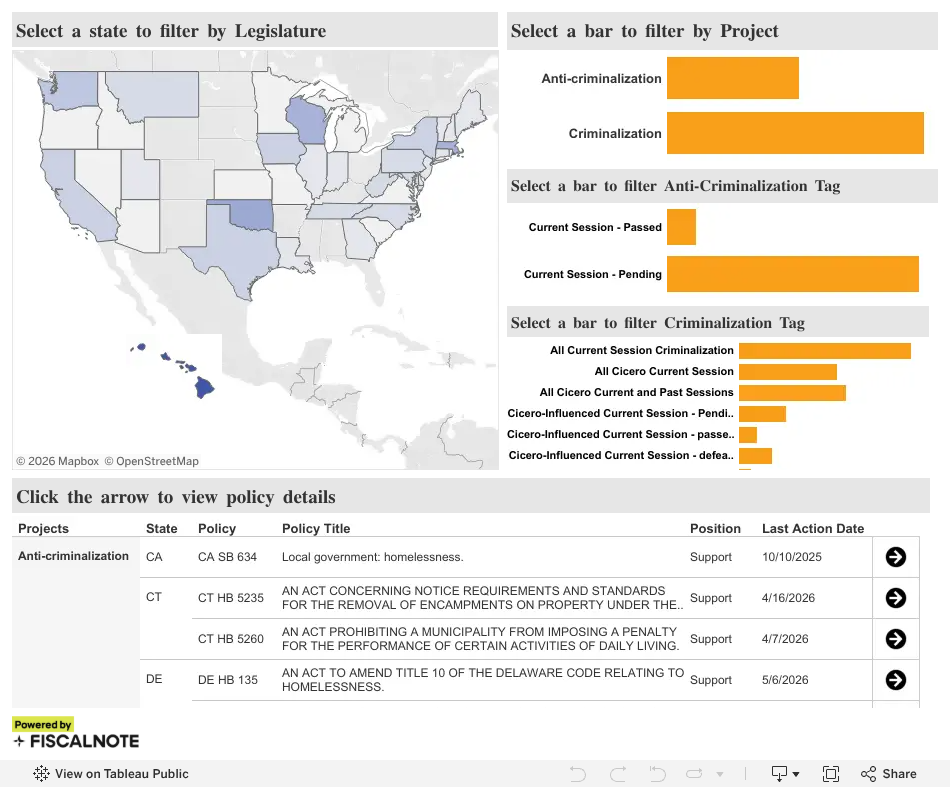
Below, you can find the Emergent Threats Map, which tracks current state-level bills that criminalize homelessness.
Background
The criminalization of homelessness has existed at the state level for centuries. Many anti-homeless laws are tied back to Victorian-era “vagrancy laws” and others to Jim Crow laws. Now, a new threat has emerged: template legislation from the Cicero Institute, a “think tank” promoting the criminalization of homelessness. These bills punish people experiencing homelessness with arrest and fines at the expense of long-term housing solutions that address the root causes of homelessness. Other bills, not directly connected to Cicero have emerged as well. Given our country’s historical racialization of criminalization and institutionalization, these policies will have deep disparate impacts on Black, Indigenous, and people of color, disabled people and LGBTQ+ people.


What is the Cicero Institute?
The Cicero Institute is a conservative think tank created to expand the criminalization of homelessness, founded by Joe Lonsdale, a billionaire Palantir cofounder. Lonsdale is a tech billionaire and venture capitalist profiting off privatization of prison and parole systems . Following the Austin City Council’s roll-back of ordinances banning camping, panhandling, and sitting and lying in public in 2019, the Institute successfully pushed Texas Governor Abbot and the state legislature to pass a statewide camping ban to override the local decriminalization efforts (and potentially push more people into his prisons).
This state override strategy was highly effective. The Cicero Institute then turned the Texas bill into a template for state legislation with four primary elements.
The Four Primary Elements of Cicero Bills
- A statewide camping ban. Penalties of up to $5,000 and one month in jail. Funding penalties to any jurisdiction that refuses to enforce the ban;
- A diversion of all federal and state funding for homeless services from evidence-based housing and services (the “Housing First” approach) to short-term state-run encampments and emergency shelters. Short time limits and paternalistic programming requirements, subject to immediate removal for failure to comply, and a grant of immunity for liability to operators of encampments for all but grossly negligent conduct;
- Lowering of due process protections to involuntarily commit people experiencing homelessness to state psychiatric institutions, paired with threat of jail or $5,000 fines for non-compliance with out-patient treatment; and
- Creation of “homeless outreach teams” funded by homelessness dollars. This requires law enforcement to force unhoused people into state-run encampments under threat of arrest.
In 2021-22, Cicero lobbyists actively courted legislators to get bills introduced in Arizona, Georgia, Missouri, Oklahoma, and Wisconsin, ultimately passing (illegally) in Missouri. Cicero also supported a bill (not based on their template) making camping a felony in Tennessee.
In 2023, legislators in Arizona reintroduced their template bill, HB 2844.
Other Examples of Homelessness Criminalization
While not explicitly based on the Cicero template, other bills of concern have emerged as well.
California
CARE Court– this law set up an alternative court system which could reduce barriers to involuntary treatment for people experiencing homelessness in California. Passed in 2022.
SB 31 – SB 31 would make it a crime to sit, lie, sleep, or store, use, maintain, or place personal property upon any street, sidewalk, or other public right-of-way within 1000 feet of a so-called “sensitive area”, including schools, daycare centers, parks, or libraries. Introduced in 2023.
AB 257 – AB 257 would prohibit a person from sitting, lying, sleeping, or storing, using, maintaining, or placing personal property in any street, sidewalk, or other public property within 500 feet of a school, daycare center, park, or library. The bill would also make willfully resisting, delaying, or obstructing a peace officer, or public officer, a misdemeanor.
Tennessee
Felony Camping Statute – this law expanded a prior state law into a statewide ban on camping on state land. Punishment of up to six years in jail and permanent disenfranchisement. Passed in 2022.
Oklahoma
Requires camps to be inspected for housing codes, and if they do not pass, then be “abolished”
Resources
National Low Income Housing Coalition Housing First Webinar Series
Summary of Cicero Threat Video
National Homelessness Law Center Testimony to Arizona Health and Human Services Committee (2023)
National Homelessness Law Center Testimony to Georgia State Senate Committee on Unsheltered Homelessness (2022)
Other anti-criminalization resources