Two years since Johnson v. Grants Pass, things have gone from bad to worse
By John Salois, Youth Shelter and Housing Attorney, and Katie Meyer Scott, Youth Homelessness Program Director, National Homelessness Law Center
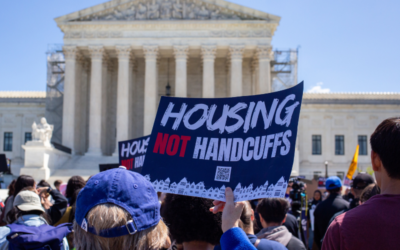
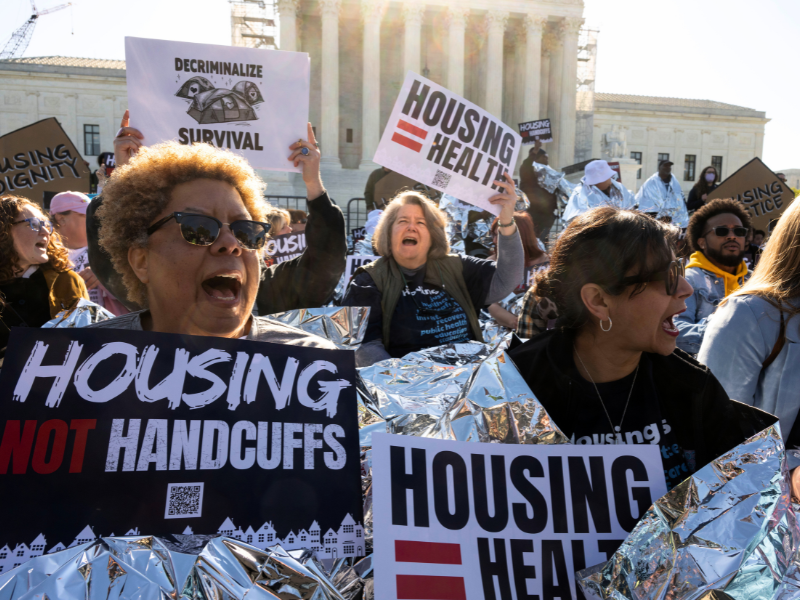
The people of Grants Pass – and especially its homeless community – have been through a lot in the last two years. There are about 600 homeless people in Grants Pass, a city of less than 40,000. During the Johnson v. Grants Pass Supreme Court case, the city was the subject of intense national focus. After the court effectively made it a crime to sleep outside in America, people stopped paying attention.
In Grants Pass, things have gone from bad to worse
Soon after the court’s decision, Grants Pass began aggressively evicting and displacing homeless people. In response advocates sued the city, assert that they were violating an Oregon law requiring policies that regulate “sitting, lying, sleeping, or keeping warm and dry outdoors on public property” to be “objectively reasonable.”1 The lawsuit led to a settlement requiring that Grants Pass ensure shelter for at least 150 people, on public property and accessible to people with disabilities. But the city has not provided even close to enough shelter beds, with the only proposed 40-unit pallet shelter significantly delayed. Instead, they are relying on three “sanctioned” encampments, parks where people are allowed to sleep without getting arrested.
Earlier this year, the city passed yet another ordinance that allows police to take and destroy people’s property. It also allows police to ban people from these parks for arbitrary reasons, like holding onto their belongings or trying to stay warm. This means that people can be kicked out of the one place in Grants Pass where they can sleep without being threatened with arrest.
Opal’s story
These policies may seem abstract, but they are impacting real people every day. Take Opal, (name changed for privacy) for example. Opal, who is homeless in Grants Pass, was excluded from all three sanctioned areas and, because of this more punitive ordinance, was banned for an additional six months. Why was Opal excluded? Because her tent is one foot too long for the strict 8×8 campsites. And because she struggles to keep up with the onerous requirement of moving her tent to different sites every four days – just like most people would struggle to pack up and move their belongings every four days – she is constantly harassed by the police.
After the city excluded Opal, she had two days to challenge the decision. One morning, just a few days after Opal filed her appeal, a police officer showed up at her tent and told her she had a scheduled hearing at the courthouse just a few hours later. Opal ran over to the courthouse and then to multiple city office buildings, but no one knew about a hearing. Finally, over an hour later, a compassionate security guard helped them locate the room where the hearing would take place.
Ultimately, Opal’s exclusion was upheld. The hearing officer told her that his hands were tied – he had no choice but to exclude her because her tent was simply too big. She now has nowhere to sleep: she is banned from the sanctioned sites, but it is illegal to sleep anywhere else in the city. There is nowhere for her to go. It’s a cruel catch-22. And Opal is far from the only person affected by this; it is now almost impossible to live in Grants Pass if you are homeless. This is exactly what the city wanted. When Grants Pass went to the Supreme Court, it was not because they were interested in solving homelessness, but because they wanted to kick homeless people out of town.
Grants Pass today
Recently, Grants Pass has been trying to take their efforts even further by allowing their city manager to unilaterally make life more difficult for people sleeping outside. Jolie, who was previously homeless in Grants Pass, attended the city council meeting on May 20 to respond. She made a passionate statement about empathy, our neighbors who are homeless, and the cruelty of the sanctioned encampments. It is worth two minutes to listen.
It doesn’t have to be like this. Instead of focusing their time and money on making life even more difficult for their homeless neighbors, Grants Pass can invest in making sure everyone has the shelter, services, and housing they need. The city can and must take up Jolie’s passionate call to treat homeless residents with compassion.